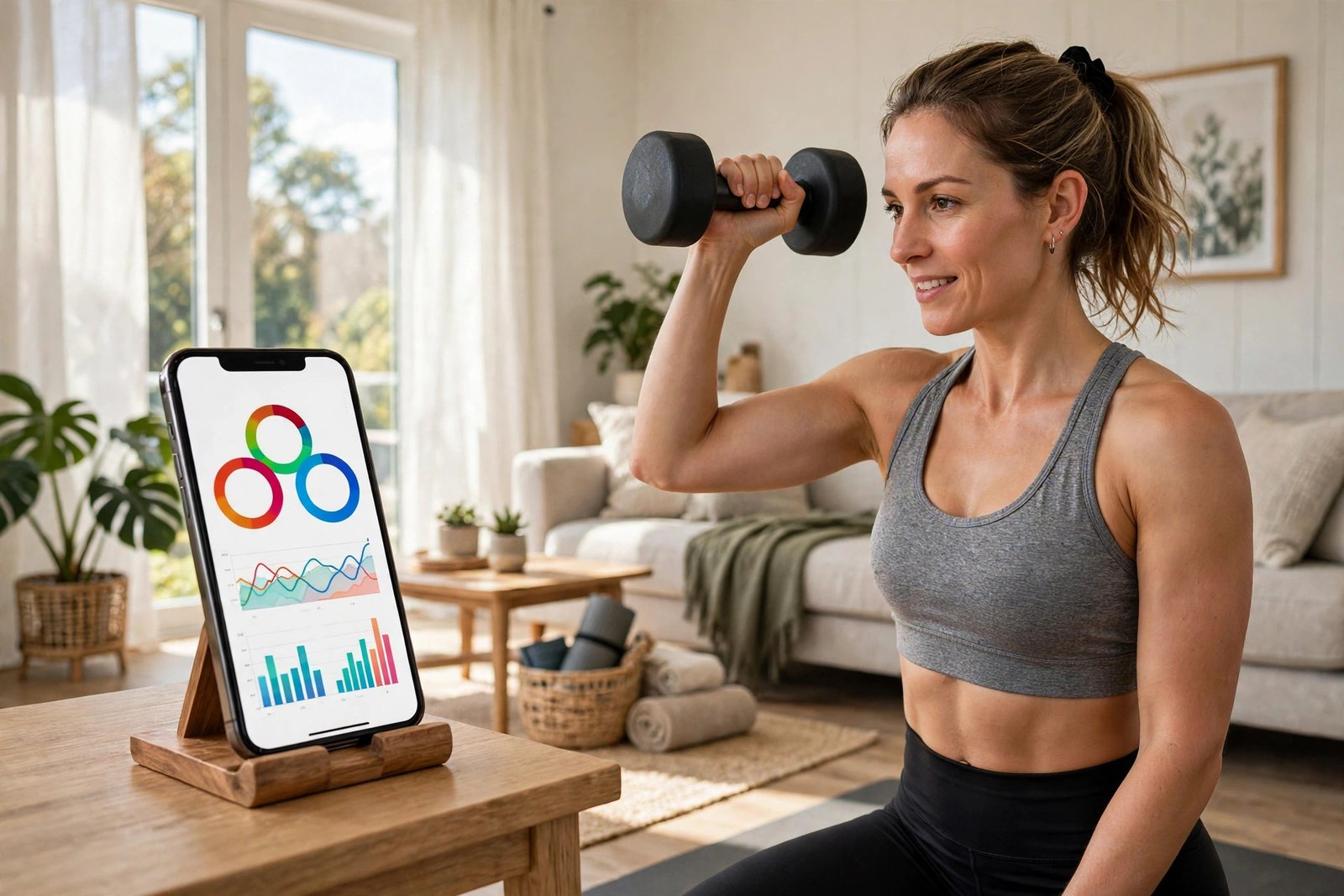
Four days I couldn’t do stairs properly. Sideways, both hands on the rail, one step at a time, while my daughter stood at the bottom, stopwatch app in hand, delighted. That was week one of my return to training, courtesy of an AI fitness app that had done nothing wrong.
Let me back up, because the app isn’t the villain of this story. I am.
First there was Freeletics, and the neighbours
I hadn’t trained in about eighteen months. Desk, car, couch. My first bright idea was bodyweight training in the living room — no equipment, no excuses — so I downloaded Freeletics, which several people had sworn by.
Day one, it handed me a workout that opened with fifty burpees. Fifty. At 6 a.m., on a second floor, above a neighbour who works nights. By burpee thirty the floor was shaking; by the end of the week there’d been a knock on my door and a conversation nobody enjoyed. The app itself? Clever. It adjusted sessions based on my feedback, it needed nothing but floor space, and a decent chunk of it was free. It also believed in me to a degree I found frankly irresponsible. On day nine, when it cheerfully lined up an even harder week, I deleted it. Deleted, not paused. Its idea of encouragement and my idea of survival were never going to meet.
Then I bought dumbbells and lied to Fitbod
A colleague tried to sell me on FitnessAI — sets your weights from your last session, no confetti, no shouting. Nearly worked. But I’d just bought a secondhand pair of adjustable dumbbells and inherited a bench my brother was throwing out, and I wanted an app that built sessions around actual kit. So: Fitbod.
Fitbod’s onboarding asks your experience level, and here is where I committed the crime. I picked “intermediate.” I had been intermediate — once, years ago, before the desk, the dodgy knee and the eighteen months of nothing. The app took my word for it. That’s the thing nobody prints on the app store page: an AI fitness app cannot see you. It doesn’t know your history unless you type it in, and it understands what you type about as well as a form does.
Monday looked harmless. Goblet squats, 16 kg, four sets of twelve. Romanian deadlifts. Walking lunges the length of the garage. I finished it smug. Thursday brought Bulgarian split squats, three sets of ten per leg, bodyweight only. How bad could bodyweight be?
Reader, it can be very bad.
Hence the stairs. Hence the stopwatch. Hence four days of lowering myself into chairs with my arms.
The physio, six weeks late
Here’s the safety part, in the middle, because the middle is where it happened to me.
In week two — I’d kept going, because stopping felt like losing — my shoulder started pinching during presses. Not agony. A pinch, up near the front, every rep. The app didn’t know. The app would have added weight the next week, smiling. I stopped that exercise, swapped it, logged the pinch in the notes, and eventually — six weeks later than I should have — saw a physio. Nothing sinister: two boring exercises and a lecture on load management.
So, plainly: none of this is medical advice, and no app gives you care. An app gives you a plan. If you’ve got a medical condition, an injury, you’re pregnant, or — like me — you’re coming back after a long layoff, talk to a doctor, a physio or a proper trainer before you start, not after the pinch. Sore muscles a day or two after training can be perfectly normal. Sharp pain is not a mindset problem. Dizziness, chest pain, pain that keeps getting worse: stop, full stop, and get it looked at. The app won’t make that judgement for you. It can’t watch your form, it can’t feel what you feel, and the “that felt easy” button is not a medical instrument.
Starting over as a beginner, because I was one
I restarted Fitbod and told it the truth this time. Beginner. Two adjustable dumbbells, up to 24 kg each. One bench. Forty minutes, three days a week. Grumpy knees, so no jumping and no deep lunges. The plan that came back looked embarrassing: Monday full body — a squat pattern, a push, a row, some core. Wednesday lighter, mobility work. Friday full body — hinge, press, pull, carries. Week one felt like a warm-up that never arrived, and I nearly “fixed” it twice.
I didn’t. By week eight I was still doing it — the first plan in years to survive contact with my actual life. That’s when I paid: the free tier gives you only a handful of workouts, and the paid month costs about what I’d spend on two coffees out. It had earned it. My rule: nobody gets my money in week one; two honest free weeks tell you more than any review, including this one. (Check the store listing first — prices and features wander.)
Logging is the other half of it. The app adjusts from what you tell it. Mark a session “easy” when it nearly ended you — I did this exactly once, on a Friday, showing off to nobody — and it adds weight; next week your form falls to pieces chasing the number. Log the bad bits instead. The skipped exercise. The pinch. The day you did half and went home. A plan built on honest logs bends. A plan built on vanity breaks around week three, usually at the knees.
The ones I didn’t live with, but people around me do
My old training partner — the one who never had an eighteen-month gap, the swine — uses JuggernautAI for powerlifting. Structured blocks, proper periodisation. I ran its trial out of curiosity and felt like I’d been handed the controls of a plane I can’t fly. It’s paid, it’s serious, and for a man relearning how to squat it is magnificent overkill. If you’re genuinely chasing strength numbers, different story.
My sister started with Nike Training Club, and I’d point any nervous beginner the same way. Guided classes, a friendly human on the screen, a good amount of it free. She didn’t want a spreadsheet; she wanted someone to follow. I did one of its “gentle” mobility classes with her and was humbled in my own living room.
And the colleague with FitnessAI is still on it, still happy, still boring about it at lunch. Had Fitbod not got to me first, it’s probably the one I’d have picked. Which is “the best”? Wrong question, and I say that as the man who typed the title. It’s whichever one’s nagging you can still stand in week six. Everything else is app-store poetry.
What I’d tell you at the start, knowing what I know now
Just this, and then I’ll stop lecturing:
- Tell it your real level. Not your historical one.
- Give it limits — kit, minutes, the knee, the neighbours — not wishes.
- Read the whole week first, and swap anything unfamiliar while you’re calm, not mid-session.
- Log honestly. Especially the bad sessions.
- Stop for sharp pain. Not after the set. Stop.
Questions people actually ask me
Are AI fitness apps safe?
Safe-ish, for generally healthy adults who start gently and learn the movements properly — with the physio paragraph above stapled to the front of that sentence. They’re planning tools, not medical professionals, and they cannot see you move. If that worries you, that’s exactly why the check-up comes first.
Can one replace a personal trainer?
No. A trainer watches you, corrects you mid-rep, and notices the thing you’d never think to type into a notes field. An app is cheaper, always awake, and perfectly fine once your basics are safe. I keep calling mine a notebook that thinks a bit.
What’s the best free option for a beginner?
At home with no kit, the Freeletics style — just warn your neighbours first. If you’d rather follow a person on a screen, Nike Training Club. Either way: free for two weeks before any money moves.
How many days a week should a beginner train?
Three, for most of us, with walking or light pottering on the others. Rest days are part of the plan, not a gap in it. My bones, several of which still remember the split squats, agree.
Why is my plan so brutally hard?
Because you lied to it, probably the way I did: level too high, feedback too proud, recovery too imaginary. Drop the level, shorten the sessions, log one truthful week. A plan you finish beats a perfect plan you abandon by Thursday. Every single time.
Last thing
I still have the video my daughter took. Fourteen seconds of her father descending his own staircase like a cliff face. I keep it for ambitious days, when my thumb hovers over “that was easy.”
Start smaller than your pride wants. Tell the truth — to the app, and in the log. Let the plan be a bit boring, and let it bend around your knees, your neighbours, your Tuesdays. Eight unglamorous weeks of that will do more for you than the brilliant programme you quit in one.